Spec Smarter, Build Faster: How Time and Auxiliary Relays Improve Panel Performance
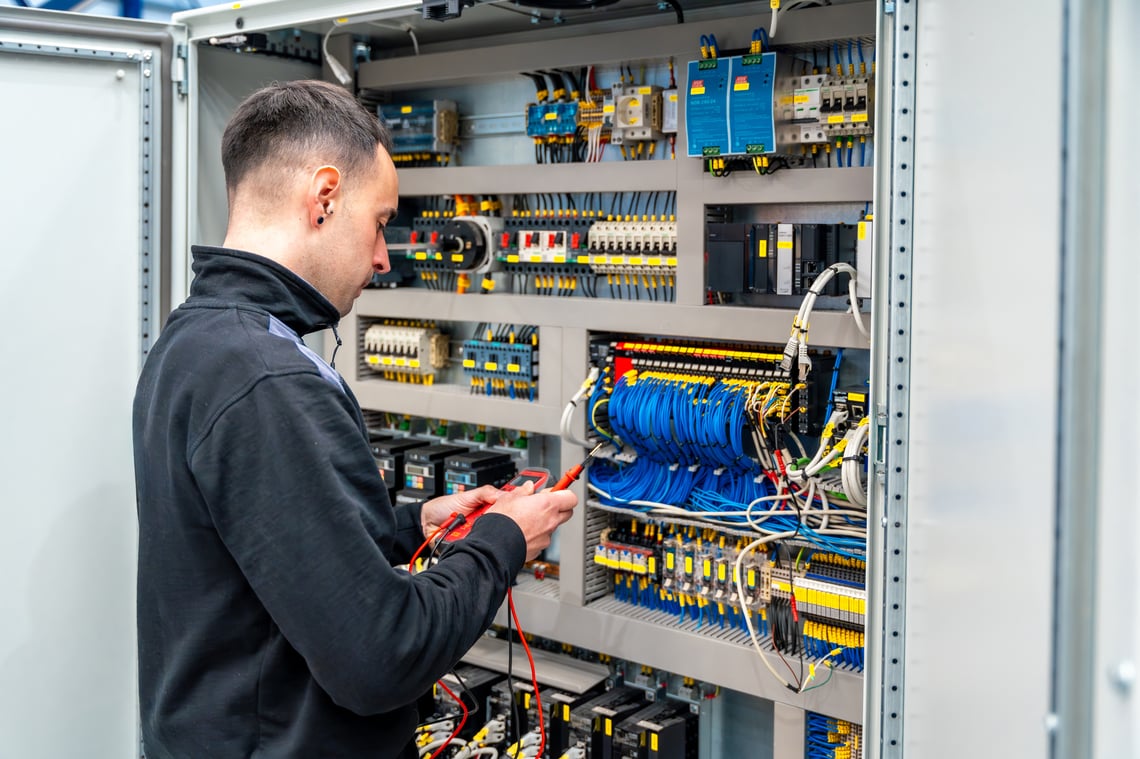
Panel shops work where design intent meets reality – tight DIN rail space, mixed voltages, unpredictable field wiring, commissioning deadlines, and the simple fact that “easy to troubleshoot” often matters as much as “meets spec.”
That’s why relays remain foundational in modern control panels. Even in PLC-heavy systems, relays still solve everyday problems more cleanly than adding I/O, rewriting logic, or complicating the BOM. Two categories do most of that work:
- Time relays that handle sequencing, delays, and timing-based interlocks
- Auxiliary (interposing/power) relays that buffer controller outputs, multiply contacts, and improve isolation
ELKO EP North America’s CRM series time relays and VS series auxiliary relays are designed around those realities in a panel shop, helping engineers and builders create panels that commission smoothly and service quickly.
What “Better” Looks Like in a Panel Shop
When a relay improves a panel system, it usually shows up in three places:
1) Cleaner design
Fewer unique part numbers, fewer special cases, simpler schematics.
2) Faster build and commissioning
Straightforward wiring, easy adjustments, clear status indication.
3) Better maintainability
Techs can diagnose issues at the door, not with a laptop and a prayer.
Time and auxiliary relays contribute to all three.
ELKO’s CRM Series Time Relays: Timing Logic That Reduces Complexity
Time relays aren’t just “delays.” In panel practice, they’re the simplest way to add predictability when equipment has start-up quirks, minimum off-times, purge requirements, or sequencing needs.
Common use cases in a panel shop for time relays
- Staged starts to reduce inrush and nuisance trips (fans, pumps, multiple motors)
- Off-delay run-on for ventilation, enclosure cooling, or purge cycles
- Anti-short-cycle protection for compressors and HVAC loads
- Interlock timing (e.g., allow the contactor to enable only after permissives stabilize)
- Pulse/interval functions for signaling, indexing, or timed actuator events
Why Engineers Spec ELKO’s CRM Relays in Timing Applications
Multifunction capability equals fewer SKUs and less redesign.
Panel shops benefit when one time relay can cover multiple timing behaviors (on-delay, off-delay, interval, pulse, cyclic timing). This reduces “one-off” part numbersand makes it easier to standardize across jobs.
Wide timing ranges support real-world variability.
In practice, timing needs change. A dust collector might need a longer post-run. A purge time may be adjusted after commissioning. Time relays with broad ranges help you absorb those changes without swapping hardware.
Control inputs matter for panel logic.
Timing often needs to respond to START/INHIBIT/RESET conditions rather than simply powering the relay. That’s the difference between a basic delay and a relay that plays nicely inside permissives and fault/reset logic.
Status visibility supports commissioning.
Panel shops know that commissioning time is expensive. When a relay provides a clear indication of state/timing, it reduces “guess-and-check” troubleshooting and shortens startup.
Panel-door adjustability can be a design win.
In some systems, timing isn’t “set and forget.” It may be tuned for changing conditions. External adjustment options can keep that tuning accessible without opening the enclosure.
ELKO’s VS Series Auxiliary Relays: Output Buffering and Contact Multiplication Without Complication
Auxiliary relays are frequently the difference between a panel that’s easy to expand and one that becomes a rework magnet.
Where auxiliary relays improve panel design
- Protecting PLC outputs by offloading coil/current demands and switching transients
- Isolating voltages (24 VDC logic controlling AC loads, or mixed control domains)
- Multiplying contacts for permissives, alarms, pilot lights, or multiple downstream devices
- Creating a clean interface between “smart” control and “dumb” loads
- Making panels more serviceable by clarifying what’s energized and when
Why Engineers Spec ELKO VS Series Auxiliary Relays
They “scale” control output cleanly.
Instead of redesigning I/O or adding modules, an auxiliary relay can expand a single signal into multiple contacts, useful for permissives, feedback loops, stacklight triggers, or safety-related signaling (where appropriate to the system architecture).
Compact DIN-rail form factor supports panel density.
Panel shops often fight for space. A relay that fits neatly into standard rail layouts helps keep builds consistent and reduces layout gymnastics.
Status indication improves field support.
A clear energized/not-energized indicator reduces troubleshooting time, especially when maintenance teams are dealing with intermittent signals or unclear logic states.
How CRM and VS Relays Work Together in Real Panel Scenarios
Here are a few practical patterns panel engineers use all the time:
1) Staged motor start and output buffering
- CRM time relay sequences motor/contactors (M1, then M2, then M3) to reduce inrush.
- VS auxiliary relay buffers the PLC output so the controller isn’t directly driving multiple coils or interfacing with noisy loads.
Result: fewer nuisance trips, cleaner logic, less stress on controller outputs.
2) Fan overrun for enclosure thermal management
- CRM off-delay keeps ventilation running after a heater or drive shuts down.
- VS relay provides additional contacts for pilot lights and alarm signaling (“fan overrun active”).
Result: more stable enclosure temps, clearer diagnostics at the door.
3) Anti-short-cycle protection for compressors or pumps
- CRM timing logic enforces a minimum off-time before allowing restart.
- VS relay provides isolation and adds contacts for permissive chains and status feedback.
Result: better equipment protection and fewer “mystery faults” caused by rapid cycling.
A Relay Selection Checklist for a Panel Shop
If you want to keep your relay decisions consistent across builds, anchor selection in a few repeatable questions:
Selecting a time relay (CRM)
- Function: On-delay, off-delay, interval, pulse, cyclic? One multifunction unit can cover many jobs.
- Timing range: What’s needed now, and what might change later during commissioning?
- Control behavior: Do you need START/INHIBIT/RESET style control?
- Adjustment method: Is panel-door adjustment desirable, or should settings be locked inside?
- Serviceability: Can a tech quickly tell what state it’s in?
Selecting an auxiliary relay (VS)
- Purpose: Buffering a controller output or multiplying contacts?
- Contact count: How many poles are needed for permissives, pilot lights, and feedback?
- Noise/isolation: Are you separating DC logic from AC loads or noisy coils?
- Maintenance clarity: Will status indication reduce troubleshooting time?
The Bottom Line for Panel Shops
In panel design, the best components aren’t just “high spec.” They’re the ones that reduce build variability, shorten commissioning, and make troubleshooting obvious.
ELKO EPNorth America’s CRM time relays and VS auxiliary relays support that goal by helping you:
- standardize timing functions without bloating your BOM,
- add sequencing and protection logic without extra PLC complexity,
- buffer outputs and multiply contacts cleanly,
- and create panels that are easier to commission and service.
Have Questions? We’re Here to Help!
Call 800-575-5562 today. Our solutions experts are ready to assist you.